Hair Transplant for Receding Hairline
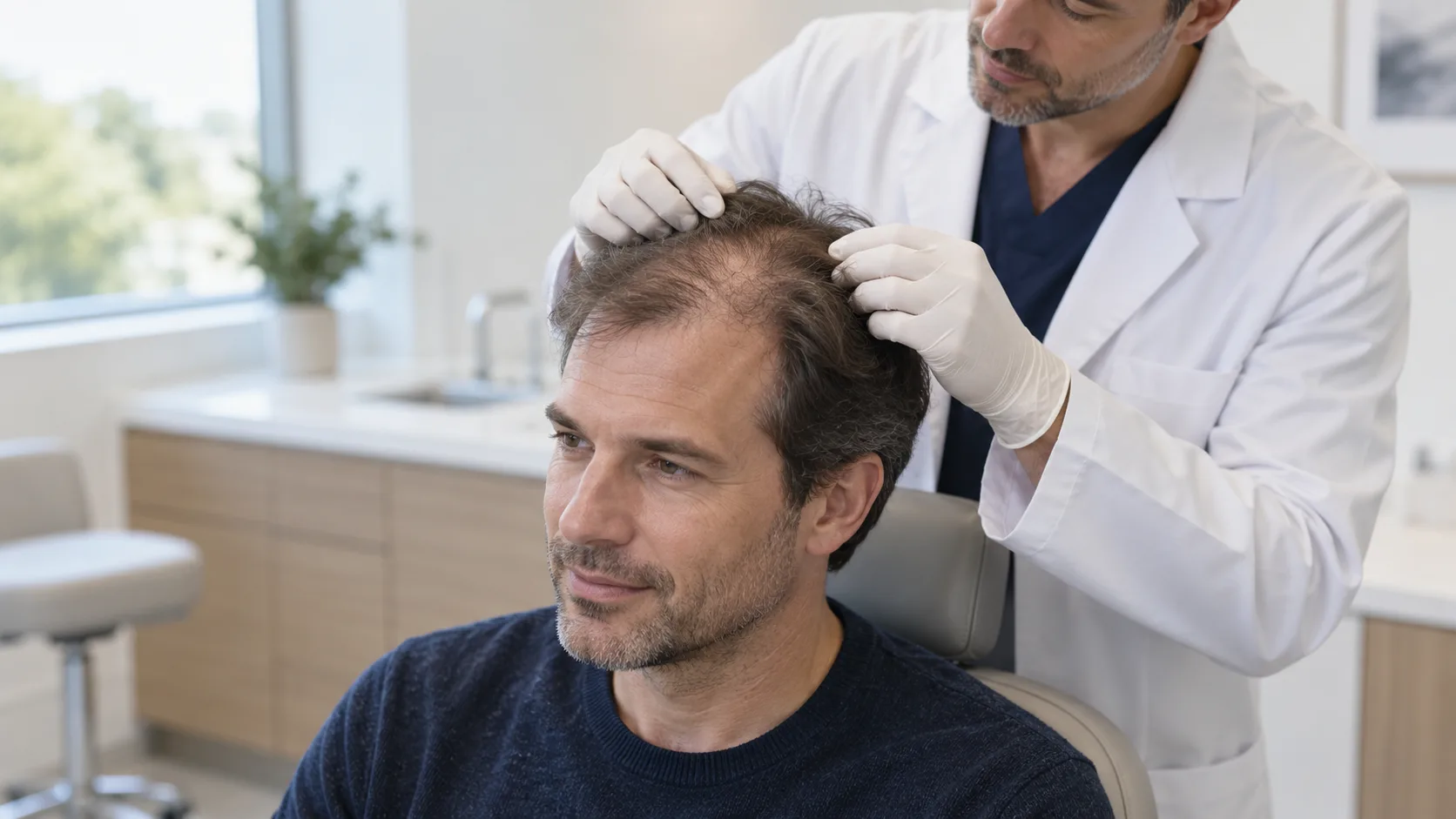
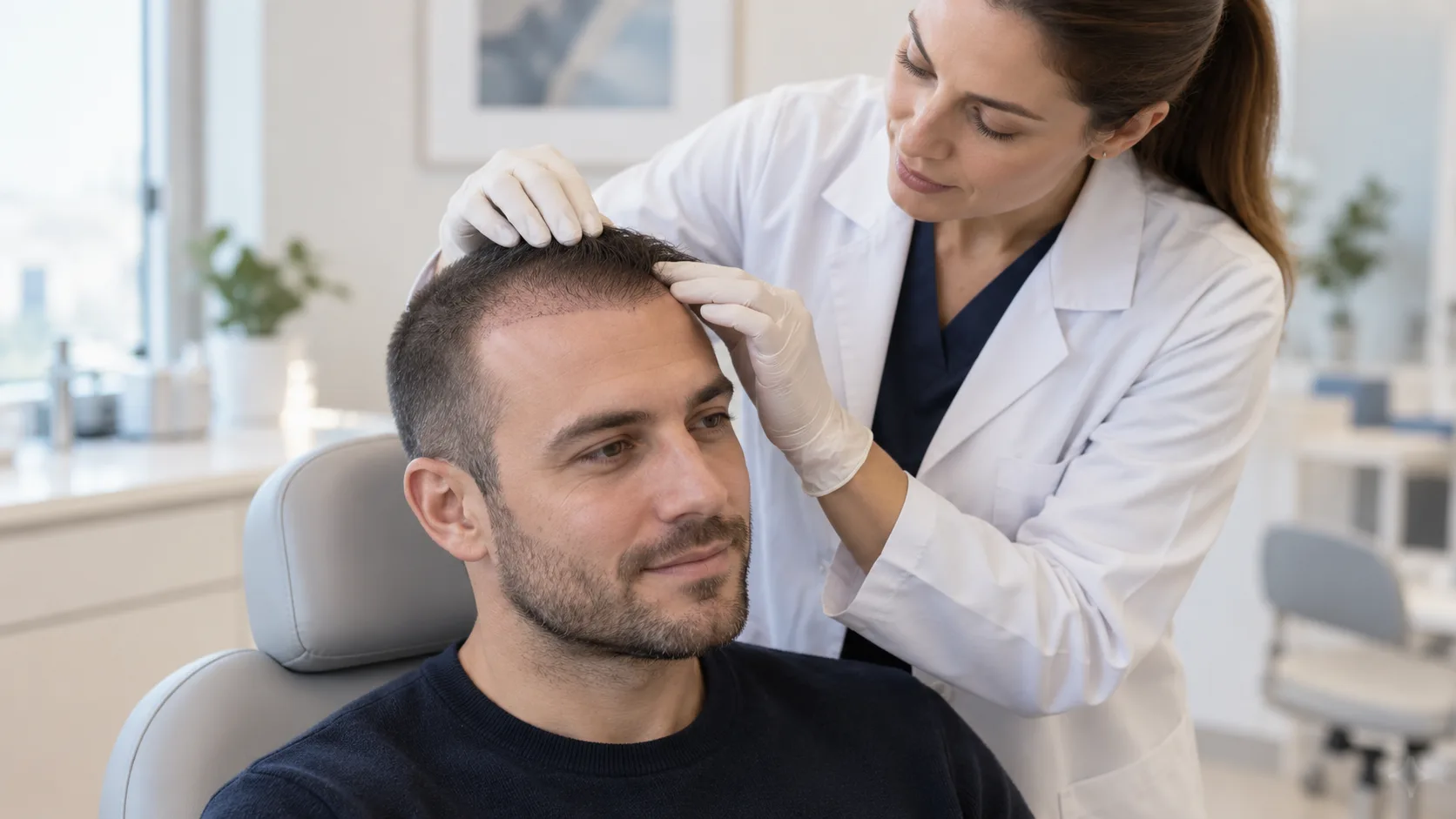
A hair transplant for a receding hairline is a surgical procedure that moves your own hair follicles from a stable donor area, usually the back or sides of the scalp, into the frontal and temple regions where recession has occurred. Because transplanted follicles keep their original genetic resistance to dihydrotestosterone (DHT), they continue to grow for the long term in their new location (Orentreich 1959). Modern follicular unit techniques, especially follicular unit extraction (FUE), allow surgeons to rebuild a natural, age-appropriate hairline with minimal scarring (Bernstein and Rassman 1999). This guide explains the causes of recession, candidacy, techniques, graft counts, natural hairline design, recovery, risks, alternatives, and long-term expectations using evidence-based information.
What Is a Receding Hairline?
A receding hairline is the gradual backward movement of the frontal hairline, most often at the temples, caused primarily by genetic sensitivity of hair follicles to DHT (Trueb 2002). It is the earliest and most common visible sign of androgenetic alopecia in men.
A receding hairline describes hair loss that starts at the front of the scalp. The frontal hairline and temples thin first because follicles in these regions carry androgen receptors that make them vulnerable to DHT. Hair at the crown and mid-scalp may follow, but the frontal pattern usually appears early.
The classic pattern is an M-shaped recession. The two frontotemporal corners retreat while a central forelock of hair remains, creating a widow's peak outline. Norwood classified these patterns into stages in 1975, and his scale remains the standard tool surgeons use to grade male pattern recession (Norwood 1975).
A naturally mature hairline differs from progressive recession. Most men develop a slightly higher hairline between ages 17 and 30 as the juvenile hairline matures. This change is mild, usually under one centimeter, and it stabilizes. Progressive recession, in contrast, continues year after year, deepens the temple corners, and often pairs with thinning at the crown.
What Causes a Receding Hairline?
The main cause is androgenetic alopecia, a genetically driven process in which DHT shrinks sensitive follicles until they stop producing visible hair (Trueb 2002). Age, hormones, traction, autoimmune disease, infections, and scarring can also move or damage the hairline.
How Does Androgenetic Alopecia Trigger Genetic Hair Loss?
Follicles at the frontal hairline carry androgen receptors. DHT binds to these receptors and shortens the growth phase of each follicle, so hairs become thinner and shorter with every cycle until the follicle miniaturizes completely (Trueb 2002).
This process is called follicular miniaturization. Each affected follicle produces a finer, shorter, lighter hair until it enters a dormant state. The observation that transplanted follicles keep their donor-area behavior led Orentreich to describe the principle of donor dominance in 1959, which forms the scientific basis of all modern hair transplantation (Orentreich 1959).
Can the Hairline Change With Age Without Disease?
Yes. Maturation of the hairline is a normal part of aging, but true recession continues and deepens beyond the mild shift seen in a mature hairline.
Distinguishing the two matters. A mature hairline stabilizes in the late twenties. Progressive recession continues into the thirties, forties, and beyond. Surgeons assess family history, rate of change, and current pattern before they plan restoration, because operating on an actively advancing pattern without a long-term plan leads to an unnatural result years later.
Which Other Conditions Can Affect the Hairline?
Alopecia areata, traction alopecia, scalp infections, scarring injuries, and hormonal disorders can all alter the hairline, and none of them responds to transplantation in the same way as androgenetic alopecia.
Alopecia areata is an autoimmune attack on follicles that creates round bald patches. Traction alopecia results from prolonged tension on the hairline, often from tight hairstyles. Fungal infections and inflammatory conditions such as folliculitis decalvans destroy follicles and replace them with scar tissue. Hormonal disorders, including thyroid disease and elevated androgen states, can also thin the frontal hair.
A correct diagnosis comes first because transplantation cannot replace follicles destroyed by active autoimmune or inflammatory disease. Surgeons must confirm androgenetic alopecia before they schedule surgery.
Can a Hair Transplant Restore a Receding Hairline?
Yes. A hair transplant restores lost frontal hair by relocating living follicles from the donor zone into the receded area. It does not create new follicles, and it cannot stop untreated native hair from thinning.
The frontal hairline and temples are well-suited recipient sites. The skin there is healthy in androgenetic alopecia, blood supply is strong, and the cosmetic impact of restoration is dramatic. Success depends on three factors. First, the patient needs adequate donor hair. Second, the hair loss pattern must be stable or predictable. Third, the underlying cause must be androgenetic, because only DHT-resistant follicles maintain growth after transfer (Orentreich 1959).
Who Is a Suitable Candidate for a Receding Hairline Hair Transplant?
A suitable candidate has stable or predictable hair loss, sufficient donor density, a healthy scalp, and realistic expectations about density and hairline position (Bernstein and Rassman 1999).
Why Does Hair Loss Stability Matter?
A stable pattern lets the surgeon design a hairline that still looks natural in ten or twenty years. An unstable pattern can outgrow the design.
Candidates whose loss is actively advancing need medical stabilization first, often with finasteride, because transplanted hair will survive while surrounding native hair keeps retreating.
How Much Donor Hair Density Is Enough?
Most surgeons want a donor density of roughly 70 to 90 follicular units per square centimeter, plus favorable hair caliber and color contrast, to achieve cosmetic coverage.
Fine, light-colored hair covers less scalp per graft than coarse, dark hair. The surgeon measures donor density and estimates the lifetime supply before committing any grafts to the hairline.
What Scalp and Health Conditions Affect Candidacy?
Healthy follicles and a well-vascularized scalp support graft survival. Uncontrolled diabetes, bleeding disorders, keloid tendencies, and active scalp disease require assessment and clearance first.
A thorough candidate evaluation weighs diagnosis, donor supply, progression pattern, and medical history rather than recession depth alone.
When Is Additional Medical Assessment Necessary?
Assessment is necessary when recession appears at a young age, progresses rapidly, presents in a woman, or follows an unusual pattern that suggests non-genetic causes.
How Is a Hair Transplant for a Receding Hairline Performed?
The procedure has two core stages. The surgeon harvests donor follicles and implants them into the recipient area. Between these stages, the team designs the hairline, prepares recipient sites, and places each graft at a precise angle and direction (Bernstein and Rassman 1999).
What Happens During Consultation and Assessment?
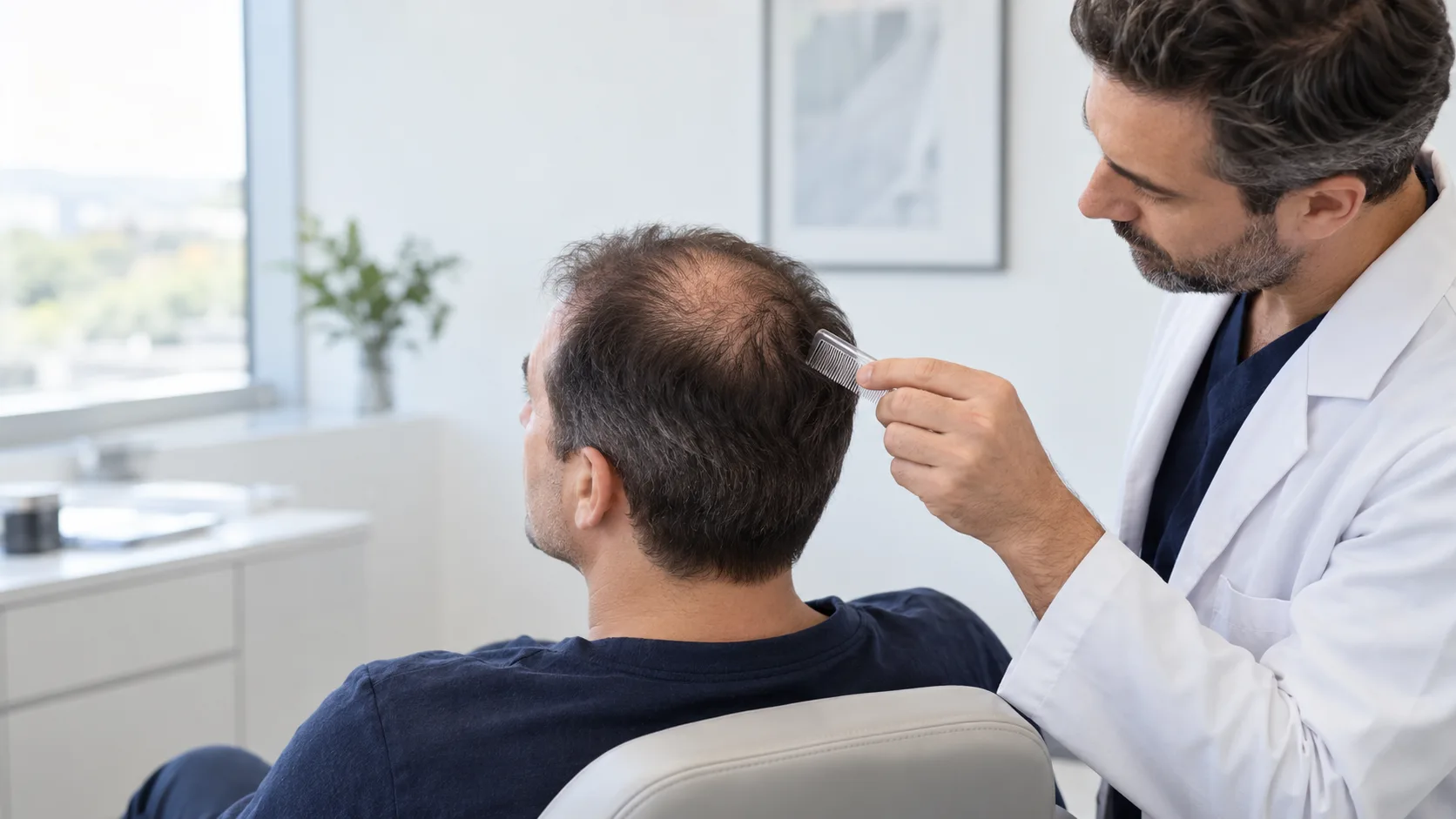
The surgeon reviews medical history, examines the scalp and donor area, measures hair density, grades the recession, and builds a long-term plan.
This stage includes dermoscopic density mapping, Norwood classification, donor-zone measurement, and discussion of medications. The long-term plan matters more than the first procedure, because hair loss is progressive.
How Is the New Hairline Designed?
The surgeon marks a hairline that fits facial proportions, matches the patient's age, shapes the temples naturally, includes slight irregularity, and blends into existing hair.
Facial thirds guide vertical position. The temple angle and frontotemporal peaks frame the face. A perfectly straight hairline looks artificial, so the design incorporates micro-irregularities that mimic natural follicular distribution.
How Are Donor Grafts Harvested?
The surgeon selects DHT-resistant follicles from the occipital and parietal zones and removes them individually or in strips.
Follicular units are natural groupings of one to four hairs first described through transverse scalp sectioning (Headington 1984). FUE removes each unit with a small punch, leaving dot-like punctures that heal quickly.
How Is the Recipient Area Prepared?
The surgeon makes tiny incisions at the recipient site that control depth, angle, direction, spacing, and distribution.
Incision sites angle forward and slightly to each side, matching natural hair flow. Density concentrates behind the hairline rather than at it, creating a soft gradient.
How Are Grafts Implanted?
Technicians place individual follicular units into the prepared sites, building a gradual density transition from the single-hair front line to multi-hair grafts behind it.
Which Hair Transplant Technique Is Used for a Receding Hairline?
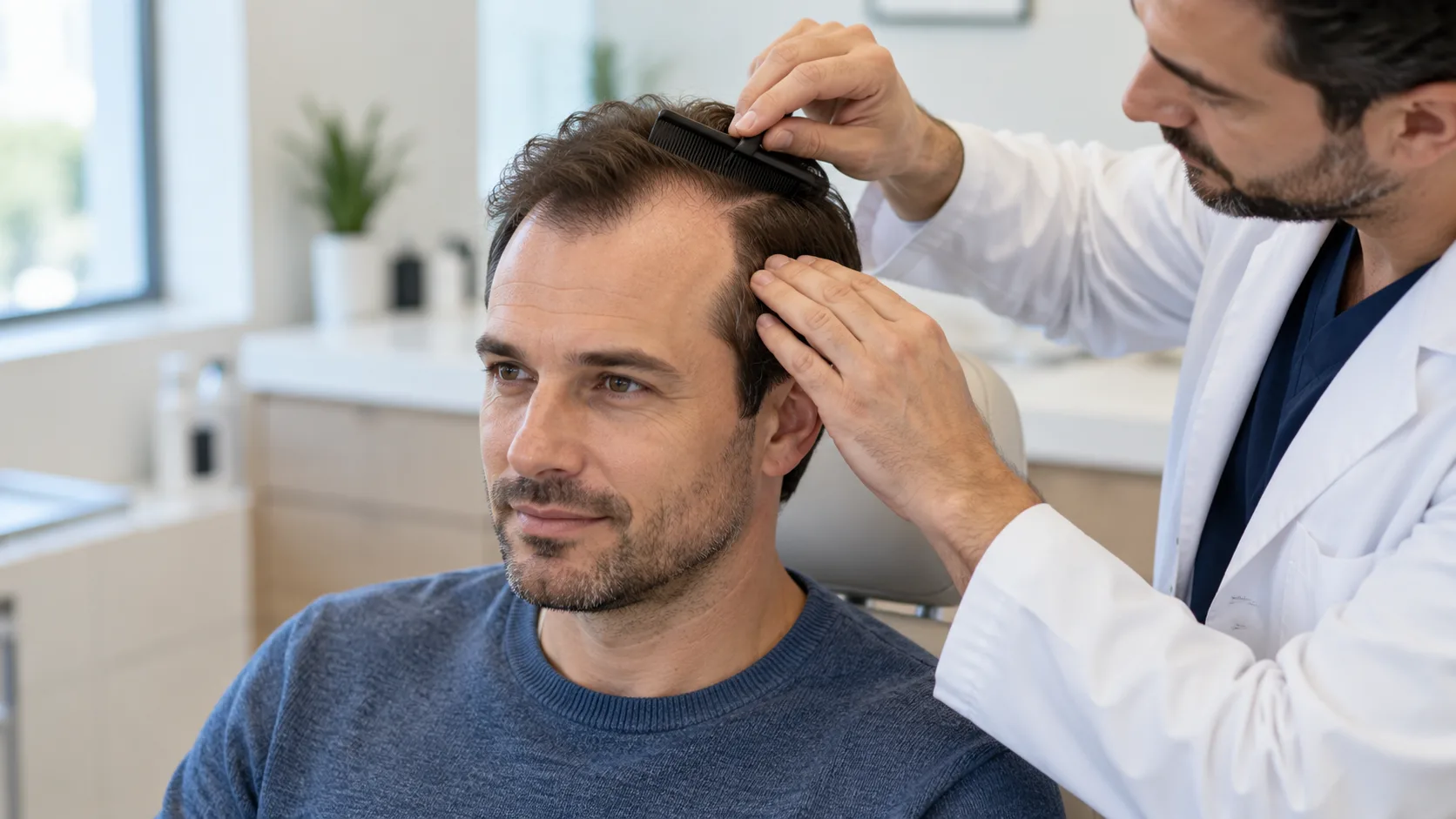
FUE is the most common technique for targeted hairline restoration because it removes individual follicles, leaves minimal scarring, and allows precise work on a small frontal zone (Bernstein and Rassman 1999).
Why Is FUE Preferred for Hairline Work?
FUE extracts follicles one at a time through submillimeter punctures. Patients keep short hairstyles easily, and the procedure suits the modest graft counts typical of frontal restoration.
How Do FUE and Strip-Based FUT Compare?
Both techniques harvest the same follicular units. They differ in scarring, recovery speed, graft yield, and how they fit each patient's goals.
Factor | FUE | FUT (Strip) |
Scarring | Tiny dot scars | Single linear scar |
Recovery | Faster, a few days | Longer, suture line healing |
Graft yield per session | Moderate | Higher in one session |
Short hairstyles | Ideal | Linear scar may show |
Best for | Small to moderate sessions | Large graft counts |
How Is the Technique Chosen?
Technique selection depends on donor density, graft requirements, hair characteristics, existing scars, hairstyle preference, and the projected long-term loss pattern.
How Many Grafts Are Needed for a Receding Hairline?
Most receding hairline cases require 500 to 2,000 grafts, but the number varies widely and must be individualized (Norwood 1975).
Graft counts depend on the degree of recession, temple involvement, desired density, recipient area size, existing hair, and donor availability. Two patients at the same Norwood stage can need very different counts. Estimates based only on a stage chart ignore hair caliber and contrast, both of which strongly affect coverage.
Recession severity | Typical graft range |
Mild temple recession | 500 to 1,000 |
Moderate frontotemporal recession | 1,000 to 1,500 |
Advanced frontal recession | 1,500 to 2,000+ |
How Is a Natural-Looking Hairline Designed?
A natural hairline combines irregularity, density gradients, age-appropriate position, correct temple angles, and a plan for future loss.
What Makes a Hairline Age-Appropriate?
An age-appropriate hairline sits higher in a 40-year-old than in a 25-year-old. Positioning a hairline too low looks unnatural later and consumes donor hair the patient may need.
How Are the Temples Reconstructed?
Temples are rebuilt with single-hair grafts that follow the natural temple angle, framed by a soft frontotemporal peak.
Why Is a Soft Transition Zone Essential?
A transition zone of fine single hairs at the leading edge prevents a hard, wall-like border and creates the feathered look of a natural hairline.
How Do Direction and Angulation Affect Results?
Grafts placed at the wrong angle stick up or point sideways. Correct forward angulation matches native hair flow.
How Is Density Balanced Against Donor Supply?
The surgeon spreads limited donor hair across the most visible zone and defers crown work when supply is tight.
Why Must Future Loss Be Planned?
Because native hair continues to thin, a good design reserves donor follicles for the next decade, not just the first result.
What Can You Expect After a Receding Hairline Transplant?
Expect redness, swelling, and tenderness for the first days, shedding of transplanted hairs within weeks, and visible new growth from months three to six, with final results around twelve months.
How Is the First Week After Surgery?
The scalp feels tender and looks red and swollen. Small scabs form around grafts and fall off within a week. Patients follow strict washing, sleeping, and activity instructions to protect the grafts.
Why Does Transplanted Hair Shed?
Transplanted hairs enter a resting phase after surgery and shed within two to six weeks. This expected process, called shock loss, is not a complication. Follicles remain alive and begin new growth cycles.
When Does New Hair Growth Begin?
New growth typically starts around month three, improves steadily through month six, and matures by twelve months.
Timeline | Expected change |
Days 1 to 10 | Redness, swelling, scabbing |
Weeks 2 to 6 | Shedding of transplanted hairs |
Months 3 to 6 | Early regrowth begins |
Months 9 to 12 | Maturing final density |
What Are the Benefits of Hair Transplantation for a Receding Hairline?
A transplant restores lost frontal hair, rebuilds temple coverage, uses the patient's own permanent follicles, and provides a long-term restoration that medical treatments cannot match (Orentreich 1959).
Unlike medications that slow loss, transplantation physically replaces follicles in the receded zone. The result grows, can be cut and styled, and requires no daily maintenance beyond normal hair care. For many patients, restoring the frame of the face delivers the largest cosmetic gain of any hair restoration option.
What Are the Risks and Limitations of a Receding Hairline Transplant?
The procedure carries surgical risks including swelling, discomfort, shock loss, infection, uneven growth, variable graft survival, and continued thinning of native hair.
Most side effects are temporary. Shock loss affects surrounding hairs and usually reverses within months. Infection is uncommon with proper aftercare. The main limitation is biological. Transplantation redistributes hair; it does not multiply it. Outcomes depend on donor supply, surgical technique, and individual healing, and some patients need a second session for added density.
Can Existing Hair Continue to Recede After a Transplant?
Yes. Transplanted follicles resist DHT, but surrounding native follicles remain vulnerable and can continue to thin.
This difference explains why long-term planning and medical maintenance matter. Finasteride can slow the miniaturization of native hair, protecting the overall result (Kaufman 1998). Patients who skip maintenance often see a growing gap between transplanted hair and retreating native hair.
What Are the Alternatives to a Hair Transplant for a Receding Hairline?
Alternatives include minoxidil, finasteride, PRP therapy, low-level light therapy, and scalp micropigmentation. These options manage hair loss or camouflage it, but none replaces permanently lost follicles.
How Does Minoxidil Work?
Minoxidil is a topical agent that prolongs the growth phase and increases hair diameter. Trials show it improves androgenetic alopecia, but benefits last only while patients use it (Olsen et al. 2007).
What Does Finasteride Do?
Finasteride blocks the conversion of testosterone to DHT, slowing follicular miniaturization at the hairline and crown (Kaufman 1998). It is prescription-only and requires medical supervision.
Is PRP Therapy Effective?
Platelet-rich plasma injections deliver growth factors to follicles. A randomized trial reported increased hair density compared with placebo (Gentile et al. 2017), though results vary and evidence is weaker than for medications.
Can Low-Level Light Therapy Help?
Low-level laser therapy stimulates cellular activity in follicles and showed benefit in controlled studies (Avci et al. 2013). It works best as an add-on, not a replacement for surgery.
What Is Scalp Micropigmentation?
Scalp micropigmentation tattoos pigment dots that mimic hair follicles. It creates the look of density or a closely shaved style without adding real hair.
Option | Adds real hair | Stops progression | Best role |
Hair transplant | Yes | No | Permanent restoration |
Minoxidil | No | Slows loss | Maintenance |
Finasteride | No | Slows loss | Maintenance |
PRP | No | Possible mild effect | Adjunct |
Low-level light | No | Mild | Adjunct |
Micropigmentation | No | No | Camouflage |
Is Hair Transplantation Suitable for Women With a Receding Hairline?
It can be, but female hair loss usually presents as diffuse thinning rather than pronounced frontal recession. Diagnosis and donor-area stability assessment are essential before surgery.
Women with female pattern hair loss keep their frontal hairline more often than men, so a visible receding hairline in a woman raises suspicion of traction alopecia, hormonal imbalance, or frontal fibrosing alopecia. Hairline design for women also differs. The line must sit lower and softer, and temple reconstruction requires extra caution to preserve a feminine frame. Medical evaluation comes before any surgical plan.
How Long Do the Results of a Receding Hairline Transplant Last?
Transplanted follicles typically last for decades because they carry DHT-resistant genetics, but the overall result depends on continued monitoring of native hair (Orentreich 1959).
Durability rests on donor selection and ongoing management. Patients who combine surgery with maintenance therapy and periodic review preserve the most natural long-term outcome.
What Should You Consider Before Choosing a Hair Transplant Surgeon?
Choose a surgeon with focused hair restoration experience, a diagnostic approach before surgery, personalized hairline design, disciplined donor management, honest risk discussion, and structured aftercare.
Ask how many hairline procedures the surgeon performs each year, request before-and-after photos of patients with similar loss patterns, and confirm that the clinic measures donor density rather than guessing graft counts. A trustworthy surgeon explains limitations, plans for future loss, and outlines aftercare in writing.
Frequently Asked Questions About Hair Transplant for Receding Hairline
Can a Hair Transplant Fix a Receding Hairline?
Yes, a hair transplant can restore a receding hairline by implanting DHT-resistant follicles into the frontal zone. Success depends on donor supply and correct diagnosis.
How Many Grafts Are Usually Needed for a Receding Hairline?
Most cases need 500 to 2,000 grafts, depending on recession depth, temple involvement, and target density.
Is FUE Suitable for a Receding Hairline?
Yes. FUE suits hairline restoration well because it offers precise placement, quick recovery, and minimal scarring (Bernstein and Rassman 1999).
Does a Hair Transplant Permanently Restore the Hairline?
Transplanted follicles usually grow permanently, but surrounding native hair can still thin without maintenance therapy.
How Long Does It Take to See the Results?
Early growth appears around month three, with final results near month twelve.
Can Women Have a Hair Transplant for a Receding Hairline?
Yes, after careful diagnosis, because female hair loss often differs from the male pattern.
Can the Transplanted Hair Fall Out?
Transplanted hairs shed temporarily in the first weeks, but follicles survive and regrow.
Can the Hairline Continue to Recede After Transplantation?
Transplanted hair resists recession, but untreated native hair can continue to thin.
Can a Hair Transplant Restore the Temples?
Yes. Surgeons rebuild temple corners with single-hair grafts angled to match natural temple flow.
Is Everyone With a Receding Hairline a Candidate for Transplantation?
No. Active autoimmune disease, insufficient donor hair, unstable loss, or unrealistic expectations can rule surgery out.
References
Avci, Parviz, et al. "Low-Level Laser (Light) Therapy (LLLT) in Skin: Stimulating, Healing, Restoring." Seminars in Cutaneous Medicine and Surgery, vol. 32, no. 1, 2013, pp. 41-52.
Bernstein, Robert M., and William R. Rassman. "The Logic of Follicular Unit Transplantation." Dermatologic Clinics, vol. 17, no. 2, 1999, pp. 277-295.
Gentile, Pietro, et al. "The Effect of Platelet-Rich Plasma in Hair Regrowth: A Randomized Placebo-Controlled Trial." Stem Cells Translational Medicine, vol. 6, no. 1, 2017, pp. 80-90.
Hamilton, James B. "Male Hormone Stimulation Is Prerequisite and an Incitant in Common Baldness." American Journal of Anatomy, vol. 71, no. 3, 1942, pp. 451-480.
Headington, John T. "Transverse Microscopic Anatomy of the Human Scalp." Archives of Dermatology, vol. 120, no. 4, 1984, pp. 449-456.
Kaufman, Keith D. "Finasteride in the Treatment of Men with Androgenetic Alopecia." Journal of the American Academy of Dermatology, vol. 39, no. 4, 1998, pp. 578-589.
Norwood, O'Tar T. "Male Pattern Baldness: Classification and Incidence." Southern Medical Journal, vol. 68, no. 11, 1975, pp. 1359-1365.
Olsen, Elise A., et al. "A Multicenter, Randomized, Placebo-Controlled, Double-Blind Clinical Trial of a Novel Formulation of 5% Minoxidil Topical Foam Versus Placebo in the Treatment of Androgenetic Alopecia in Men." Journal of the American Academy of Dermatology, vol. 57, no. 5, 2007, pp. 767-774.
Orentreich, Norman. "Autografts in Alopecias and Other Selected Dermatological Conditions." Annals of the New York Academy of Sciences, vol. 83, 1959, pp. 463-479.
Trueb, Ralph M. "Molecular Mechanisms of Androgenetic Alopecia." Experimental Gerontology, vol. 37, no. 8-9, 2002, pp. 981-990.